
Operational Intelligence Platform for Mining
PIPER connects data from your historians, SCADA, PLCs, laboratory, and ERP, adds operational context, and turns it into dashboards, KPIs, and reports your plant can act on in real time.
The Problem
Your mine already generates the data. The challenge is using it in time.
- Disconnected data: plant, lab, maintenance, and ERP data live in separate systems, and every report is built by hand.
- Late decisions: shift reports and month-end closings arrive after the loss has already happened.
- Downtime with no clear cause: events are logged in spreadsheets or free text, making it hard to know which losses to tackle first.
- Tags without context: a signal name doesn’t say which asset, process, or product it belongs to.
The Solution
From plant signals to operating decisions
- 1. Connect. PIPER Collector integrates with historians, SCADA, PLCs, laboratory systems, and ERP through interfaces and APIs.
- 2. Contextualize. PIPER Historian stores the data, and PIPER Modeler organizes it by asset, process, and event and calculates KPIs.
- 3. Act. PIPER View delivers dashboards, reports, and alerts to operations, maintenance, and management.
- Works with what you already have. If your operation already runs AVEVA PI System, PIPER can work as an additional layer on top of it, with no need to replace it. Deploy in the cloud or on-premise.
Open Industrial Architecture
Built for cloud, hybrid, and on-premise operations, PIPER View integrates OT/IT systems through a modern and scalable architecture designed for critical industrial operations.
- Typical mining applications: SAG mills, crushing and grinding, flotation, conveyor belts, tailings, haul trucks, energy consumption, water management, and real-time production monitoring.
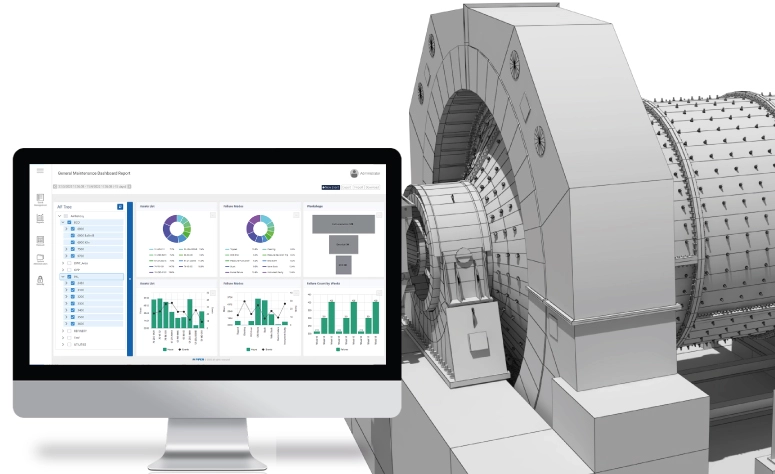
The single, trusted source of operational information to drive decisions and improve productive performance.
PIPER Downtimes
PIPER comprehensively manages operational stoppages, transforming them into clear and actionable information for decision‑making.
The model enables the registration, classification, and analysis of planned and unplanned stops, and integrates with the PIPER application to identify causes, measure impact, and relate downtime to OEE and key KPIs.
With PIPER, organizations gain real performance visibility, prioritize the most critical losses, and establish a solid foundation for continuous improvement and operational efficiency.
More than measuring stoppages, PIPER turns downtime into opportunities for improvement.
PIPER Balance
The Metallurgical Balance Model enables the analysis and reconciliation of mass and metal flows in metallurgical processes by integrating feed, product, and tailings data. It supports the calculation of recoveries, metal losses, and effective production, ensuring consistent closure of mass and metal balances and high data integrity.
Implemented in PIPER Modeler, the model incorporates data reliability–based reconciliation, metallurgical KPIs, multimetal analysis, and stage-level traceability, providing a robust foundation for operational control, process optimization, and decision support.
PIPER Quality
The model in PIPER Modeler will be developed in accordance with the required business logic, taking into account the available data sources, the defined operational rules, and the calculation criteria necessary to ensure consistency, traceability, and reliability of the indicators.
PIPER MBC
The Condition-Based Model in Mining, implemented in PIPER, evaluates operational performance based on the fulfillment of critical process conditions, using key variables, technical thresholds, and logical rules. This approach transforms operational data into condition states, enabling proactive operational control.
The model is applicable to mining and processing assets, such as crushers, mills, flotation circuits, leaching systems, and material handling, incorporating the asset-specific operational techniques of each system. It supports the identification of deviations, the definition of optimal operating windows, and the generation of condition-based KPIs, enabling asset optimization and fact‑based decision-making under real operating conditions.
PIPER Energy
PIPER Energy Intelligence enables real-time monitoring and optimization of energy consumption in mining and industrial operations.
The platform integrates process, asset, and energy system data to deliver contextualized operational visibility, energy KPIs, and advanced analytics.
It enables:
- real-time energy monitoring
- operational energy efficiency
- energy vs. production correlation
- overconsumption detection
- demand and consumption optimization
Transforming energy data into operational intelligence to improve efficiency, reduce costs, and accelerate decision-making.
PIPER Costs
The Cost Model in PIPER Modeler integrates financial information from ERP systems such as SAP with online operational data on consumption and production, enabling the calculation of real and unit operational costs under actual operating conditions. The model combines accounting costs with process variables such as energy, consumables, and processed tonnage, ensuring full traceability and consistency between finance and operations.
This integration enables the dynamic calculation of costs by asset, process, or time period, the identification of cost drivers, and the generation of operational economic KPIs, providing a solid foundation for cost control, economic optimization, and data‑driven decision‑making.
True digital transformation is fueled by reliable and available real-time data
OPERATIONAL INTELIGENCE PLATFORM consolidates and streamlines information, freeing teams from the burden of cluttered data and allowing them to focus on strategic tasks. From a robust database to intelligent information management, this system provides the support needed to make more accurate and strategic decisions.